How to Double Donations: A Guide to Matching Gifts
Imagine if every time a supporter handed you a $50 bill, someone else stepped out from behind the curtain and handed you another $50.
That is exactly how corporate matching gifts work, yet billions of dollars in this "free money" go unclaimed every single year. Why? Because most donors simply don't realize their employers offer these programs, and busy nonprofits often lack a clear system to guide them.
If your organization has been treating matching gifts as a nice-to-have bonus rather than a core fundraising strategy, you’re leaving major funding on the table.
The good news? You don’t need a massive team or a huge budget to capture it. By making a few approachable tweaks to your website, forms, and follow-ups, you can build an automated engine that naturally multiplies your revenue.
Here is your four-step playbook to scaling your matching gift donations.
Step 1: Create a Dedicated Website Hub
Your website is the digital front door for your donors. If information about corporate matches is buried in a dense footer link or completely absent, your supporters won’t even know it's an option.
To capture this revenue, you need to create a dedicated matching gifts landing page. Keep it approachable and focus on these core elements:
- A Clear, Direct Headline: Use something inviting and impact-focused, like "Double Your Impact Without Spending an Extra Dollar."
- The 30-Second Explanation: Briefly explain that many companies match their employees' charitable contributions. If you want a stellar real-world example, look at University of Georgia; their matching gift hub makes the concept instantly intuitive for everyday supporters.
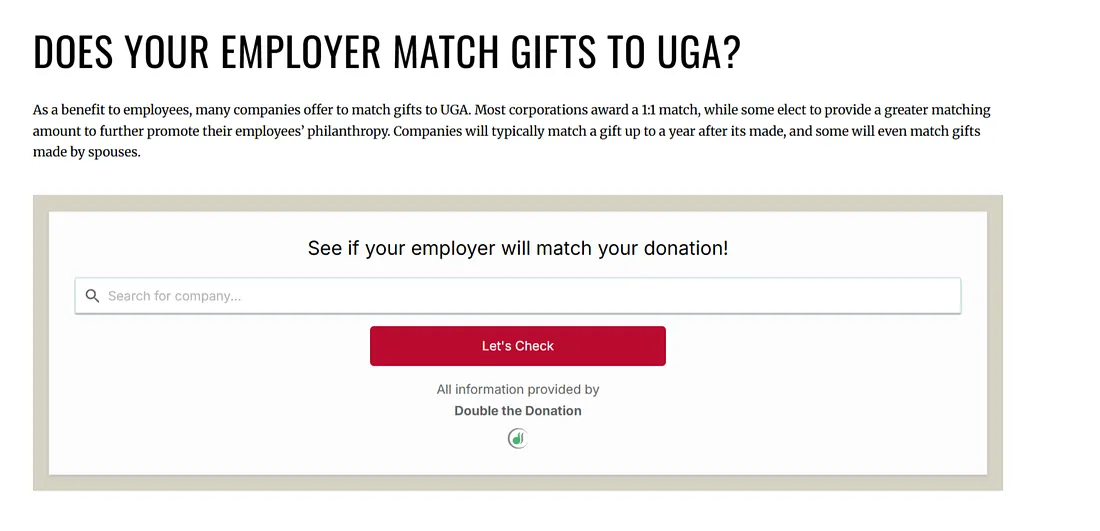
Example: The University of Georgia's matching gift landing page with an embedded employer search tool. - An Embedded Search Tool: Integrate a searchable employer database tool (like Double the Donation) directly onto the page. Donors can type in their company name and instantly view their employer’s specific matching guidelines, deadlines, and submission forms.
- A Simple FAQ Section: Answer the most common questions upfront. What happens if someone is retired? (Many companies still match!) What if they are a part-time employee? What if their spouse works for a matching gift company?
By building this central hub, you create a seamless, self-service resource that empowers donors to take action the moment inspiration strikes.
Step 2: Proactively Collect Supporter Employment Info
You cannot proactively pursue matching gifts if you don’t know where your donors work. Many organizations wait around hoping donors will initiate the process on their own, but the most successful nonprofits take a proactive approach. The easiest way to do that? Ask for employment data right at the moment of giving.
Adding a single, friction-free field to your donation form is the ultimate catalyst for matching gift outreach. Once you know a donor's employer, you can instantly identify matching opportunities behind the scenes.
For the best results, keep data collection light, optional, and impact-focused.
- The In-Form Autocomplete Field: Add a corporate employer field directly on your main checkout page. Pair it with a supportive tooltip like, "Type your company name here to see if they will match your donation!"
- The Confirmation Page Plugin: Additionally, embed an employer search tool on the "Thank You" confirmation page immediately after the payment is processed. Donor enthusiasm is still at an all-time high, so be sure to take advantage of it.
- Non-Donation Touchpoints: Don't limit data collection to just your giving page. Add an optional employment field to your volunteer sign-up sheets, event registrations (like gala tickets or walk-a-thons), and email subscription forms.
See how Cleveland State University Foundation does so here:
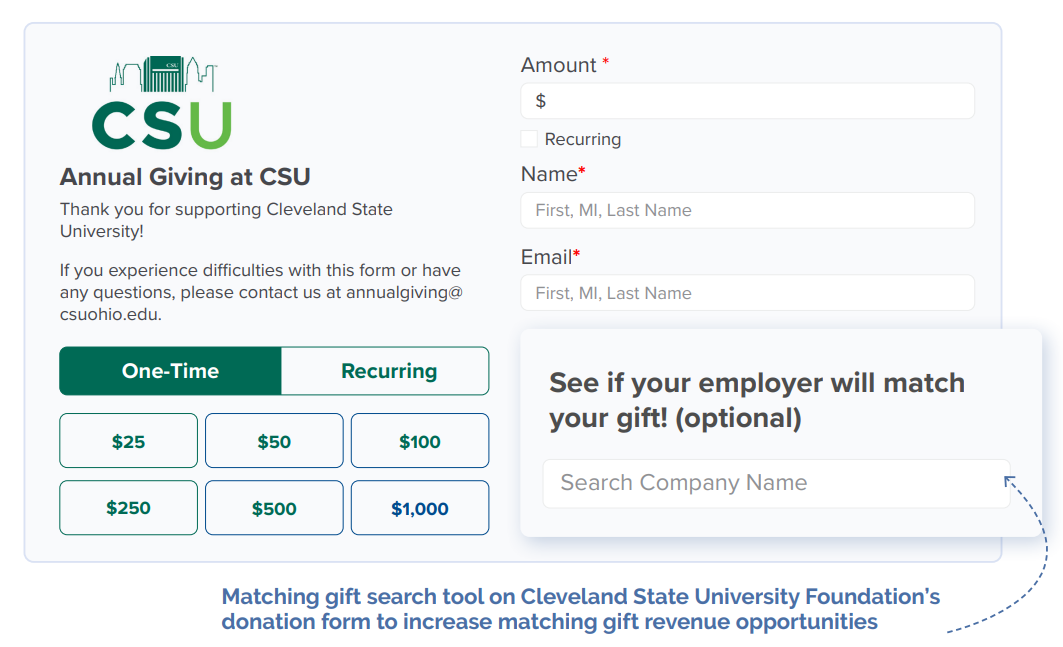
This simple integrated search tool played a significant role in the foundation’s uncovering more than $55K in matching gifts!
Step 3: Follow-Up with Donors After They Give
The moment a donation is completed, the clock starts ticking. Most donors genuinely want to maximize their impact, but life gets busy, and submitting a match request to their corporate HR portal easily slips their minds.
To bridge the gap between a donor’s good intentions and an actual corporate payout, your nonprofit needs a structured, approachable follow-up loop.
The 3-Phase Follow-Up Blueprint
Instead of blasting your entire email list with generic reminders, segment your communications based on the employment data you collected in Step 2. Here is a highly effective, automated cadence you can set up:
| Phase | Timing | Channel | Friendly Strategy |
|---|---|---|---|
| 1. The Instant Prompt | Immediate | On-Screen & Email Receipt | Don't just say thank you. Right below their receipt, provide a direct link to their employer’s corporate giving portal while their excitement is still fresh. |
| 2. The Gentle Nudge | Within 24 hours of the initial donation | Personalized Email | Send a warm, dedicated follow-up. Keep the tone helpful: "Hey [Name], we noticed your company matches gifts! Here is the 2-minute link to double your impact." |
| 3. The Year-End Close | Late Nov / December | Email & SMS | Run a corporate deadline campaign. Remind donors that many Fortune 500 company match matches reset on December 31st, so they need to submit before they lose those funds. |
Keep the Focus on Impact, Not Paperwork
When you follow up, avoid sounding like an accountant asking for administrative paperwork. Rather, focus entirely on what those extra matching dollars will achieve.
Instead of saying, "Please submit your corporate matching forms," frame it as a team effort:
"Your $50 gift is already helping us provide meals for families in our community. Taking two minutes to request a match from your employer will turn that into $100, doubling the number of families we can serve this month."
By automating these friendly reminders, you keep the momentum going (and ensure no match-eligible gifts slip through the cracks) without adding extra daily tasks to your team's plate.
Step 4: Spotlight Matching Gift Donors to Create Social Proof
Humans naturally look to others to guide their behavior. In the fundraising world, when donors see people just like them successfully doubling their impact, they are far more likely to raise their hands and say, "I want to do that too." By publicly celebrating supporters who take that extra step, you create powerful social proof that demystifies the matching process and inspires your broader community.
3 Friendly Ways to Build Social Proof
- Share Micro-Stories on Social Media: You don’t need a long, formal case study. A quick, enthusiastic shout-out works wonders. For example: "Big thank you to Sarah, one of our incredible local volunteers! She donated $100 last month, checked her employer’s policy, and just unlocked a $100 match from her company. Total impact: $200 for our after-school programs! 🙌"
- Launch a "Double Your Impact" Giving Week: Create a time-bound campaign with a specific, community-driven goal. Let your audience know you’re aiming for a set number of matched gifts in a single week (e.g., "Our goal is 50 corporate matched donations by Friday"). Update a visual tracker on your website or social stories daily to build excitement and momentum.
- Publicly Thank Corporate Partners: When an employer fulfills a match, give them a nod in your newsletter or on LinkedIn. Not only does this show deep gratitude, but it also alerts other employees that their workplace actively participates in the program.
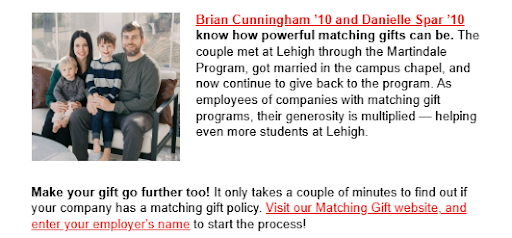
Take a look at this example from Lehigh University’s donor spotlight campaign:
Leveling Up: Turning Social Proof into Long-Term Partnerships
As your matching gift program grows, you will start to notice trends. If you see that multiple donations are being matched by the same local business or tech company, use that data to pick up the phone.
Reach out to their corporate social responsibility (CSR) or HR team and offer a warm thank you. From there, you can explore deeper, mutually beneficial collaborations:
- Co-Branded Challenges: Ask if they would be willing to sponsor a special corporate matching day exclusively for their employees.
- Expanded Benefits: Transition a simple matching relationship into volunteer grant programs (where the company pays your nonprofit for the hours their employees spend volunteering with you) or corporate sponsorships for your next big event.
When you treat matching gifts not just as isolated transactions, but as a celebratory community effort, you unlock hidden funding, deepen donor loyalty, and build strong corporate friendships that last for years.
Wrapping Up: Final Thoughts on Doubling Donations
Doubling your fundraising revenue doesn’t have to mean working twice as hard, nor does it require doubling your acquisition budget. The secret is unlocking the full potential of the incredible supporters already present in your network.
Corporate matching gifts are the ultimate win-win: your donors maximize their personal impact, corporate partners fulfill their social responsibility goals, and your nonprofit secures the vital funding needed to advance your mission.
By transitioning from a passive mindset to the proactive, four-step strategy outlined above, you pull back the curtain on workplace giving and make it effortless for your community to champion your cause.
Deepen Your Workplace Strategy
Ready to take your workplace giving strategy to the next level?